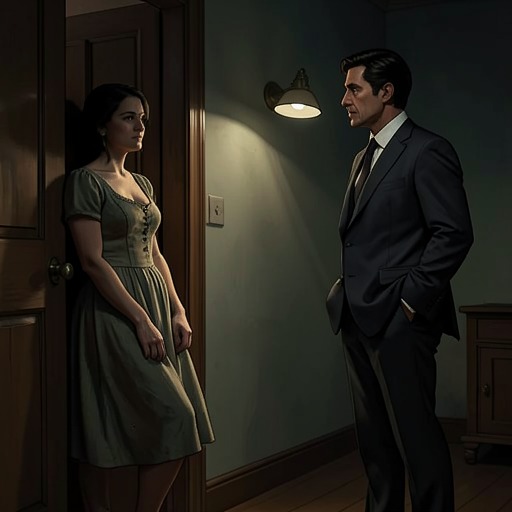
Connie's alienation and restlessness
Lady Chatterley's LoverConnie's alienation and restlessness mark the growing failure of the life she shares with Clifford Chatterley: routine, books, and intellectual talk cannot restore her sense of connection to herself or the world. The estrangement first registers in her body, drives her away from the house and its company, and eventually spreads into her understanding of her marriage and the celebrated public life Clifford has built.
Onset in a Life of Routine
Time passes in the Chatterleys' household without any felt change. Connie and Clifford live among ideas and books, and people are regularly entertained at Wragby; the clock advances, but its ordinary progress does not amount to a meaningful movement in her life. Against this suspended routine, a restlessness takes hold. The contrast matters: the disturbance is not a response to some single event, but an accumulating state within a life that seems outwardly occupied and inwardly disconnected.
The change is physical as well as emotional. Connie finds her limbs and posture unsettled, her heart beating violently without an apparent reason, and herself growing thinner. She experiences the restlessness as something arising from within her body, not as a considered decision or a problem she can reason away. The novel makes that bodily disturbance the first clear sign that her composure and habitual existence are failing.
Withdrawal and the Limits of the Wood
To escape the house, Connie rushes across the park, leaves Clifford behind, and lies in the bracken. She seeks distance from the household and from the people around her; the wood becomes her one refuge from that immediate pressure. Her withdrawal is therefore active, but it does not yet provide a way back to meaningful life. She goes there to get away, rather than because she has found a sustaining relation to the place.
Connie recognizes that limitation. Although the wood offers seclusion, she does not feel connected to its life or spirit; it is a place apart from other people, not a source of fellowship or renewal. This distinction keeps her retreat from becoming a simple cure. The physical distance from Wragby gives temporary relief, but the deeper estrangement remains: she has lost contact with what she understands as the substantial and vital world.
From Disconnection to Nothingness
Connie only vaguely understands that she is coming apart and feels unable to change the condition by confronting it directly. Clifford and his books, once the substance of their shared life, increasingly seem insubstantial to her. The narrative's movement from bodily agitation to this sense of emptiness links her personal restlessness with the intellectual world that surrounds her: words and ideas are present, but no longer seem to connect either spouse to a lived reality.
As the years pass, this perception reaches their marriage itself. Clifford speaks of their intimacy as an established bond and can, when animated, talk brilliantly about a future in which Connie might bear an heir to Wragby. Yet the next day those words seem to her to have lost their force. The gap between his confidence in language and her experience of its failure sharpens her isolation. Their shared life, which rests on habit and is sustained in conversation, can become blank to her; words remain, but she no longer trusts them to signify a living connection.
Public Display and the Wider World
The emptiness Connie perceives is not confined to private life. Clifford becomes almost famous: his books earn him a thousand pounds, his photograph appears widely, and galleries display both a bust and a portrait of him. In four or five years he becomes one of the best-known young intellectuals. Connie doubts the substance beneath that reputation. His clever analyses divide people and motives into pieces, but, in her judgment, leave nothing whole or vital behind. The contrast between growing recognition and her inward sense of vacancy makes success another form of display rather than evidence of fulfilled life.
She also reads unrest at Tevershall through this same bleakness. The colliers are talking again of a strike, but Connie does not see their agitation as a fresh release of energy. She understands it instead as the delayed surfacing of the war's damage, a deep collective discontent that would require a new hope to overcome. That perception extends her private estrangement into a social one: the words of a marriage, the talk of public success, and the agitation of a community all seem inadequate to the underlying injury and lack of vitality.
The repeated insistence on nothingness gathers these strands together. Connie's bodily unease, her ineffective refuge, the blankness she finds in her marriage, and the public display surrounding Clifford's success are not separate episodes so much as related expressions of her lost connection. Her alienation is the condition that makes ordinary routine, intellectual accomplishment, and social prominence appear unable to answer the need for a more substantial life.